Hoyer: We Cannot Turn the Clock Back to the Time Before the ADA
WASHINGTON, DC – Today, Congressman Steny H. Hoyer (MD-05) delivered remarks on the House Floor ahead of the 36th anniversary of the Americans with Disabilities Act (ADA) on Sunday, July 26th, 2026. Below are a video and transcription of his remarks:
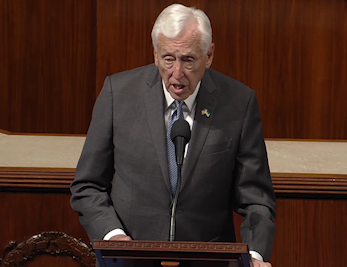
Click here to watch a video of his remarks.
"Mr. Speaker, one of the proudest moments of my time in public service was sponsoring the Americans with Disabilities Act and seeing it through to enactment. I was honored to work closely with House and Senate colleagues – leaders like Bob Dole, Tom Harkin, Tony Coelho, Steve Bartlett, Orrin Hatch, and Ted Kennedy – just to name a few. We passed it on a bipartisan basis, and it was signed into law by President George H.W. Bush in 1990. This month, we celebrate the 36th anniversary of the ADA. In those 36 years, that law has made a transformative difference for millions of Americans. It did so not only for physical access to public and private space of public accommodations, but also on ensuring reasonable accommodations in workplaces and non-discrimination and every facet of American life.
"And we've seen it strengthened through legislation like the ADA Amendments Act in 2008 and through the courts, with decisions like Olmstead v. LC in 1999. That decision concerned the ADA's nondiscrimination rule – and applied it to the forced segregation of disabled people away from their communities, a historic tragedy in centuries past. The Olmstead ruling affirmed that states are required to provide disability services in the most integrated setting possible in schools, workplaces, and even individual homes. Last month, the Department of Justice issued new guidance that the ADA does not guarantee, according to them, a right to live and receive services in integrated settings. Instead, it reinterprets the Olmstead decision as only prohibiting states from unnecessarily institutionalizing those with disabilities without adequate justification, and that it did not establish a general ‘integration mandate.’ Frankly, that's absurd. Olmstead merely affirmed what Congress had clearly intended in the ADA. Unlike when we speculate on what our founders' intent was and paraphrasing certain parts of our Constitution, when it comes to laws enacted 36 years ago, we can go right to the source.
"Let me be absolutely and unambiguously clear as the House sponsor of the ADA: an ‘integration mandate,’ as outlined correctly in the Olmstead ruling, was our intent. Senators Dole, Kennedy, and Hatch may no longer be here to state it, but I'm sure former Senator Harkin and former Representative Coelho, Bartlett, and others who were involved in drafting and enacting the law will affirm the same. Among the findings expressly listed in the text of the ADA was that, and I quote, ‘Society has tended to isolate and segregate individuals with disabilities, and despite some improvements, such forms of discrimination against individuals with disabilities continue to be a serious and pervasive social problem,' so said the Olmstead case. So, the Department of Justice is wrong and ought to retract its new guidance to states and communities.
"At the same time, we've also seen the Trump Administration use disability rights as an excuse to undermine ballot access and trample on the Help America Vote Act, which I also had the honor of sponsoring. The same principle just outlined about Olmstead applies here as well. It was never Congress's intent in writing the ADA that accommodating people with disabilities should be used as an excuse to limit America's right to vote, just as it should not be issuing a rule penalizing Americans with disabilities for living at home with their families and their caregivers and slashing Medicaid funding upon which so many in the disability community rely. I certainly hope statements like this one – from someone who was intimately involved in the writing of the ADA and stated from the Floor – will serve as a reminder of the legislative intent of the ADA and of the Congress. It is truly all about nondiscrimination, public accommodation, equal access, and, yes, integration as much as possible within communities.
"We cannot turn the clock back to the time before the ADA, when those with disabilities were ostracized, isolated, and locked away. I am proud of the part I played in changing that. And all of us, all of us, should be proud that this institution came through and delivered in both promise and practice. Let us continue to do so today. I yield back the balance of my time."