Hoyer: Forging Consensus Requires Compromise, and It’s Up to Leadership to Lead by Example
November 19, 2026
WASHINGTON, DC – Today, Congressman Steny H. Hoyer (MD-05) delivered the first installment of closing remarks on the House Floor ahead of his retirement at the end of the 119th Congress. Below are a video and his remarks as prepared for delivery:
Image
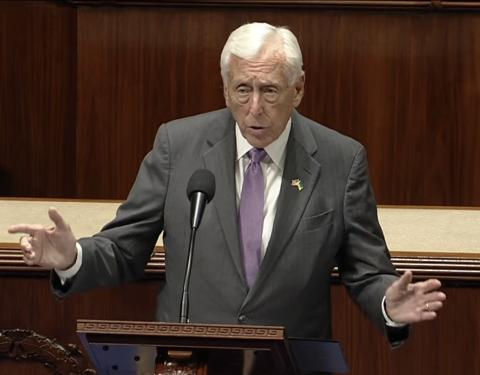
Click here to watch a video of his remarks.
“Mr. Speaker, I want to thank my colleagues for indulging me with the time, both today and in the days to come, before we adjourn the 119th Congress. As will surprise no one, I am reflecting on forty-five years in the House.
“I will begin with a question many Americans are now asking – one that Congress and its leaders have a responsibility to address: does American democracy still work?
“Is democracy still the best method of ensuring that every individual’s rights are respected, that our communities can grow and prosper, and that all have an equal chance to be heard and to pursue happiness? And is it still the best way to transform division into consensus?
“My answer is a definitive ‘yes!’
“But we hear more often, both abroad and at home, that democracy is too inefficient, too slow, too chaotic to meet today’s challenges. Such is the worldview promoted by Xi Jinping, Vladimir Putin, and other autocrats. And it finds adherents among the current President of the United States and senior members of his administration, including Stephen Miller, Russell Vought, and Tom Homan.
“For our Founders, democracy was a big bet. A leap of faith in the wisdom and good nature of ordinary people. That they would choose leaders who would work together to solve problems and to improve Americans’ lives.
“That is the operating theory of democracy: entrust a few elected representatives with power, surround them with checks and accountability, and they will use that power for the benefit of all – not to empower and enrich themselves. The closer those representatives are to those who elect them, the higher the chance of success. That is why Congress exists and why it sits at the heart of the system our Founders established.
“Like other modern legislatures, Congress has developed a system of order on the Floor in order to ensure the fair and efficient conduct of the people’s business. To translate a diversity of ideas and priorities into actionable legislation.
“That is the premise of our two-party system and why we maintain leadership roles on both sides to run the Floor and negotiate agreements.
“It was a profound honor to be selected by my Caucus to serve in leadership for over three decades, including as Caucus Chair, Steering Committee Co-Chair, Democratic Whip, and Majority Leader. That experience taught me a great deal about how this institution is supposed to work – and what happens to our democracy when it doesn’t.
“The balance of success and failure in this institution almost always hinges on its leadership. But, of course, followership is a critical and irreplaceable requirement.
“Leaders rarely begin with consensus. A leader’s job is to create enough consensus to enable collective action. Doing so requires listening, trust, patience, understanding what others need, and accepting that nobody – not even the leader – will get everything he or she wants.
“I remember, almost exactly five years ago, when we were trying to get two major bills passed. Both were central pillars of Democrats’ economic agenda. The first was the bipartisan infrastructure bill. The second was the Build Back Better Act.
“The Senate had already passed a compromise bipartisan infrastructure bill 69-30 in August 2019. It had strong public support, and the President was eager to sign it into law. The only remaining obstacle was House passage.
“When we returned to Washington that September, Speaker Pelosi and I understood the challenge ahead of us.
“One group of Democrats was determined to vote for the infrastructure bill only if it were attached to the Build Back Better Act, which was still in draft form at the time and not yet introduced. They worried that, without passing them together, the infrastructure bill would be signed into law and the Build Back Better Act would be left behind.
“Another group of Democrats wanted to vote for the infrastructure bill on its own. They didn’t want to wait the other legislation, worried that the momentum behind the infrastructure bill might be lost if it were attached to the second bill.
“There were tough conversations. We listened. We heard Members tell us why they believed they couldn’t budge. We explained our thinking. We brought the two sides together to talk through the problem. And we made it clear to Members that we understood not all of them could get to ‘yes’ – and that was okay. As long as the House got to 218.
“In late October, that hard work paid off. The consensus took shape. On November 5, 2021, the House passed the bipartisan infrastructure bill 228-206.
“Two weeks later, on November 19, we passed the Build Back Better Act 220-213, with all but one Democrat in support.
“We didn’t start from consensus – far from it. Two groups within our Majority had staked out firm and opposite positions. But we got it done.
“Not with absolutism. Not with threats.
“It demands patience, flexibility, and a willingness to put yourself in the shoes of those you’re asking to walk a difficult path. Forging consensus requires compromise, and it’s up to leadership to lead by that example.
“Too often in our contemporary politics, compromise is treated as weakness and inflexibility as strength. My experience in House and Caucus leadership, however, taught me the opposite.
“Refusing to compromise is easy. But assembling a majority that can exercise power – counting to 218, with the listening and humility that requires – that takes skill, patience, and a willingness to compromise constructively.
“In the 117th Congress, we embraced what I have called the ‘psychology of consensus’ – and, with a very thin Majority, never lost a vote on a major bill on this Floor. Not because Democrats always agreed. Not because we insisted on unanimity. But because we worked hard to make sure everyone remembered that we were all on the same team. That meant making room for some on the team to step off the field without consequence and making room for Republicans to join us. Sometimes it meant saying ‘yes’ to Members, and sometimes it meant having to say: ‘no – not this time, but we’ll keep trying.’
“We built consensus by listening, reasoning together, and building trust.
“That’s how our leadership team made the 117th Congress one of the most-productive and most consequential in modern American history – even with the narrowest of margins.
“We enacted the American Rescue Plan to lift us out of the pandemic. We enacted the bipartisan CHIPS and Science Act to reinvigorate American manufacturing and secure our supply chains. And we enacted bipartisan legislation to expand background checks and make our communities safer from gun violence. The ‘psychology of consensus’ also made possible, of course, the Bipartisan Infrastructure Law.
“I hope leadership on both sides of the 120th Congress will heed the lessons of the 117th. Listen to Members and learn what they can support – and what they cannot. Adapt and adjust to that reality while still driving toward the essential objective. Never forget that creating consensus is essential to achieving progress.
“Of course, the most durable solutions are bipartisan ones. Only with real buy-in from both sides can we make lasting progress on our toughest challenges.
“I’ve experienced firsthand how true this is.
“In 1990, as Chair of the Democratic Caucus, I worked with Democrats and Republicans – including Steve Bartlett, Bob Dole, President George H.W. Bush, Tom Harkin, and numerous other Democrats and Republicans – to enact the Americans with Disabilities Act into law. Tens of millions of Americans with disabilities have since seen doors opened, opportunities expanded, and dignity restored. The negotiations were tough and protracted, but the bipartisan result was historic.
“As Majority Leader in 2010, I reached across the aisle to build consensus around finally ending the discriminatory ‘Don’t Ask, Don’t Tell’ policy. Many on the Republican side also understood how detrimental it was to our national security and to our democracy to prevent gay and lesbian Americans from openly serving in our military, and the bill passed with bipartisan support. We got that fixed – together.
“In 2013, I helped lead a group of Democrats and Republicans to reauthorize the Export-Import Bank over the objection of the Chairman of the Financial Services Committee. Many Americans may not have heard of the Ex-Im Bank, but it plays a major role in promoting American innovation, manufacturing, and job growth. Working with Frank Lucas, a Republican from Oklahoma, and many other Republicans and Democrats, we discharged a reauthorization bill from the Committee and passed it with majorities from both parties. We got it done – together.
“And, of course, during the 117th Congress, we brought Republicans along with us to pass the Bipartisan Infrastructure Law and the Bipartisan Safer Communities Act. Together.
“This year, I worked closely with Ranking Member Gregory Meeks, Reps. Marcy Kaptur, Don Bacon, Brian Fitzpatrick, Bill Keating, and Kevin Kiley to discharge and pass the Ukraine Support Act in the House. Later, many of us worked across the aisle with former Chairman McCaul, Chairman Mike Rogers, Rep. Joe Wilson and Senators. Graham and McConnell – and with Senators Blumenthal and Shaheen – to support Ukraine by enacting the most-sweeping sanctions ever imposed against Russia. That bill enjoyed the overwhelming support of the Senate and 60% of the House. President Trump signed it into law. However, shortly thereafter, he did exactly the opposite of what the law called for, when he waived – rather than imposed – the sanctions it anticipated.
“Notwithstanding that act of betrayal, I remain proud of the bipartisan legislative victory we achieved and hope it can still serve as the basis for strong American support for Ukraine, for global democracy, and for international law.
“All of these demonstrate how the psychology of consensus can deliver bipartisan achievements, and not just advance the Majority’s agenda.
“I will also offer an example – the chief one, I believe – of how a failure to seek consensus has led to a missed opportunity.
“For years, the broad parameters of a comprehensive, bipartisan deal to fix our broken immigration system have been clear: pair stricter border enforcement with a pathway to legal status for those with no criminal record. In 2013, a group of eight senators – four Democrats, four Republicans – worked out a deal to effectuate that vision. Their bill also expanded visas for those with in-demand skills and strengthened verification programs to ensure workers hired for jobs have legal status.
“In a major breakthrough, the Senate passed their bill 68-32. It was a resounding bipartisan victory.
“When the bill arrived in the House, nothing happened. Speaker Boehner, facing a revolt from the Freedom Caucus, chose not to get to 218 with Democratic votes. Instead, he held fast to the Hastert Rule, which said that only a bill having support from a majority of the Majority party should be brought to the Floor. That rule was antithetical to sound leadership and democratic responsibility. To his credit, Speaker Boehner, for the best interest of the country, did not always follow that rule.
“What could have been a crowning moment for John Boehner’s speakership, as well as for this institution and for our democracy, became an opportunity lost – because he and his leadership team did not honor the same psychology of consensus demonstrated by the United States Senate.
“Today, the area where the psychology of consensus was most applied when I first came to Congress – but, perhaps, is most needed now – is appropriations.
“Mr. Speaker, the successful and timely completion of annual appropriations is Congress’s basic governing test. The cost of failure is borne not by Members or leadership but by the American people and by those who do business every day with our government – as well as those needing our help and information. And, of course, by the civil servants who labor for our country patriotically and faithfully and who are forced to go without pay during a shutdown.
“I have been a member of the Appropriations Committee since 1983. I am the senior-most Democratic Member of that Committee and the Ranking Member of the Financial Services and General Government Subcommittee. I am proud to sit on that Committee. But I am greatly dismayed by how dysfunctional our appropriations process has become.
“With appropriations, failure can be expressed two ways: government shutdowns and a reliance on continuing resolutions.
“During my forty-five years in the House, shutdowns have occurred seventeen times, nine of them during the Ronald Reagan and George H.W. Bush Administrations. However, those Reagan- and Bush-era shutdowns lasted, on average, less than two days. Most were over weekends.
“Compare that with the shutdowns that have occurred since 1995. That year, Speaker Gingrich forced a twenty-one-day shutdown as a negotiating tactic against the Clinton Administration. The sixteen-day shutdown in 2013 was part of an attempt to repeal the Affordable Care Act. In 2018, we had a thirty-four-day shutdown under President Trump.
“Then, last year we had a record-breaking, forty-three-day full-government shutdown, during which President Trump’s OMB Director, Russell Vought, said that ‘The appropriations process has to be less bipartisan.’ President Trump himself told Republican leaders in Congress not even to negotiate with Democrats. ‘Don’t even bother dealing with them,’ he said.
“Finally, earlier this year, the Department of Homeland Security was shut down for seventy-six days.
“The four longest shutdowns of the past twenty years together cost our economy an estimated $40 billion.
“The normalization of shutdowns reflects an antipathy toward compromise that is as dangerous as it is costly. ‘Don’t even bother dealing with them.’ The process needs to be ‘less bipartisan.’ That is the opposite of the psychology of consensus. It is the psychology of confrontation – and a recipe for failure.
“But the normalization of shutdowns is only half the equation. The other is the normalization of governing by continuing resolution. One might also call that the psychology of December.
“The last time Congress enacted all of its appropriation bills before the start of the new fiscal year was 1996 – thirty years ago. For sixteen of the last twenty fiscal years, including FY27, Congress has not enacted a single appropriation bill on time. Not a single one.
“At the same time, we’ve operated under continuing resolutions for longer and longer each year. For the decade between FY01 and FY10, we averaged 108 days a year under continuing resolutions. In the decade that followed, that figure rose to 142 days a year. In FY24, we had 160 days under continuing resolutions. In FY25, it was 165. For the fiscal year we just completed, FY26, that number was 211.
“We have reached a point where, even if the Committee does its work and produces bills, House leadership expects to reach the end of the fiscal year without all bills being enacted. In fact, it is now the expectation that we will not pass appropriation bills in a timely fashion. Calls for restoring regular order in appropriations are met with a shrug. The Senate is the major reason, and both Republicans and Democrats there routinely believe they don’t have enough Floor time to consider appropriation bills. This year, not a single appropriation bill was advanced to the Senate Floor before the fiscal year ended.
“Every time we fail to work together to fund our government on time, that is a vote of no-confidence in all of us, in the Congress, and in our democracy. Appropriations are the basic test: when neither side can act alone, the choice ultimately becomes consensus or failure.
“If we can fix our appropriations, we will go a long way toward restoring faith in this institution. Leadership – on both sides – must drive that change.
“So, leadership must choose the psychology of consensus.
“Leadership’s job is to count to 218. Not just to get bills through the House, but to ensure they can pass the Senate and be signed by the President. Whether getting appropriation bills done or delivering on a policy agenda, leadership’s goal must always be to make Congress work. To prove that democracy works.
“I keep coming back to the 117th Congress, because it is a powerful proof-point. When we first convened, Democrats had a Majority of 222-212, meaning we could only afford to lose five votes on our side. With vacancies, there were times when that margin was down to just three votes. The Senate was split fifty-fifty, with Vice President Harris as the tie-breaker. Despite those narrow margins, we enacted consequential legislation at a steady pace, delivering on our promises and showing how Congress can work for the people.
“Contrast that with the dysfunction we’ve seen in the subsequent two Congresses. The Republican leadership team in the 118th Congress faced exactly the same margin that we had two years prior: 222-212. In the 119th Congress, their margin grew even tighter.
“The difference was that Republican leadership was unable to effect consensus within their own Majority and unwilling to reach across the aisle. Previous Republican speakers, of course, had reached across the aisle and paid the price in loss of support within their Conference.
“Division instead of a team mentality. Threats instead of flexibility for Members in tough districts. Snubbing instead of seeking bipartisanship. Treating compromise as weakness instead of as an essential tool of governing.
“Speaker Johnson, on September 1, had the audacity to claim that this, the 119th Congress, ‘has literally been the most productive, successful, and aggressive Congress since 1949 – and I think it’s in the top five of all time.’
“That’s a Trumpian, extremely hyperbolic, and patently false statement!
“I think the Speaker is confusing noise for music, activity for achievement. The American people don’t give Congress a participation trophy. Scheduling and passing messaging bills that will never get a vote in the Senate – or giving speeches about what your side wants to do or what you don’t like about the other side – that isn’t the same as delivering results.
“That’s not governing. It’s a failure of leadership. And if leadership is comfortable calling this productive or successful, they won’t last in leadership or the Majority very long. The American people loudly declared that proposition on November 3.
“The lesson of forty-five years in Congress and twenty-five years in leadership isn’t that bipartisanship always works or that principle should be sacrificed. It’s that principle without a path to successful action results in the fear, frustration, and disdain reflected in the recent election.
“Rigidity is a weakness, not a strength. And our democracy itself is weakened by the refusal to work toward compromise and consensus.
“To those who will follow in House leadership – on both sides – I issue this challenge: demonstrate your strength by showing where you can bend without breaking. Translate your convictions into outcomes in a House filled with colleagues who won’t share all of those convictions.
“In short: lead with a bias toward consensus, collaboration, and success, not with a ‘my-way-or-the-highway’ conviction. Seek consensus. Build consensus. Whether among your own party or with help from across the aisle. Prove that this institution can act. Prove it can deliver. Prove that we can work together for America and its people.
“Prove that our democracy still works.
“It is up to the leaders of the People’s House to demonstrate that ‘government of the people, by the people, and for the people’ is still our greatest chance at success.”