Hoyer Remarks at Urban Institute's Improving Access to State Tax Credits through Research to Action Panel Discussion
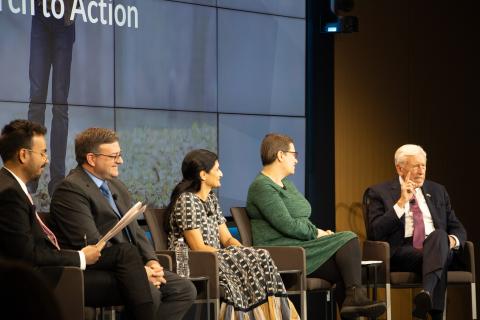
“Thank you. I've been involved in taxes for 68 years (audience laughter) - paying. But I'm pleased to be here at the Urban Institute, so thank you, Sarah, for all you do. I apologize because I'm going to say a few words and then I have to leave because we just [had] votes. You can’t always count on the time when you have votes. My job is to adopt policy that I believe is good for the citizens of our country and the citizens of my constituency, obviously. (Motions to panelists) Their job is to implement what I do and if they don't implement it, it doesn't get done. If we don't facilitate people knowing what the policy is, it doesn't get done and the purpose for which I vote does not get accomplished. And, I have a theory of why that does not happen, and it's called the YOYO theory. The YOYO theory is a very simple one, which I think, frankly, is the major premise and policy of the party that I'm not in: You’re On Your Own. YOYO.
“Direct File, which Brooke Lierman talked about – I want to say we have the best comptroller in America. Not a lot of people don’t know what a comptroller is or does, but I will tell you that Brooke Lierman, as our comptroller – I have now served in office since 1967 [in] January. She has been the most involved in making sure that people aren’t on their own, that they know what their benefits are, they know how to access their benefits, and they are facilitating and doing exactly that. Brooke, thank you so much for being such a caring, involved, smart tax collector (audience laughter) because that's what, technically, she is. We send it to Brooke Lierman, and she sends it back to us so soon, to me. But Direct File was a program that was tested, it wasn't just thrown out there. It was tested to see: Does it work? Does it effectively carry out a policy of helping people know how to do their taxes? Because most Americans want to pay their taxes, because they want – because they're honest and they want – you know, we call it a voluntary system, [but] for the large amount of our citizens it's not so voluntary. Every week, every bi-week, every month, Uncle Sam gets his or her cut, depending upon your perspective, but the cut that is necessary for democracy to work. Taxes. The ‘price of freedom.’
“Direct File was tried on a relatively small number of people, a couple hundred thousand people, and it worked so well [that] they enlarged it. And then it worked so well with overwhelming support of the users with a savings that you mentioned [were an] average $160 to $170 on average for people, because they want to pay their taxes, they want to make sure they're right and they sometimes have to pay people or spend an inordinate amount of time going through what are relatively complex directions. So, Direct File was a way to say, ‘You, by law, need to pay these taxes, and we're going to help you follow the law,’ and not have the anxiety that ‘Oh my goodness,’ you hear these ads on TV, you know, ‘Ultimate tax system is going to make sure your wages garnished, your home foreclosed on,’ all this et cetera, et cetera. So, ‘You're On Your Own’ says they’re not going to help. So, that program is now extinct. Why? Because they fired everybody who carried out that program, why because they thought, ‘We do not need to do this.’ We, being the government. ‘You're On Your Own.’ And it's like minimum wage, it's like the Affordable Care Act, You're On Your Own. It's so many things. I have a long list that you don’t have the time for, nor do you have the interest (audience laughter).
“But remember the principle because it is the underlying concept that a lot of the reductions in services. The IRS is being decimated, not just on Direct File, decimated in terms of people who make sure that those who owe taxes pay them. Why? Because [if] those who owe taxes don't pay them, guess what? Those costs of that are – and interest over the rest of us, so taxes need to be higher than they otherwise would be if everybody paid. But when I talk about that, we're talking $600 billion, give or take, lost revenue every year. So that what I do as the Ranking Member on the committee that oversees the Treasury Department and IRS is to make sure that services are available. So, when you pick up the phone, somebody answers. That costs the government some money, but it is a service that we ought to be performing when people are trying to comply with the law.
“So I'll leave it at that, because I could go on and on about what we're doing at the federal level, which is not good in terms of everyday people trying to A), make their lives affordable – you talked about affordability, we work on affordability, it’s obviously the issue of the era, because so many people are finding it impossible to pay the cost of living that they want maintain for themselves and their families. Thank you. I’m going to jump ship, but not because – (gestures to panelists) these three who really, as I say, implement policy. What I do is make words on a piece of paper. I don't make anything happen. Members of Congress don’t make anything happen. It is those of you who work every day, as you say, on helping people, helping them know what is due, and making sure America is all it can be. Thank you very much.”