Hoyer Remarks at American Enterprise Institute Bush v. Gore and the Help America Vote Act, 25 Years Later Conference
WASHINGTON, DC – Congressman Steny H. Hoyer (MD-05) delivered remarks during the American Enterprise Institute Bush v. Gore and the Help America Vote Act, 25 Years Later Conference. Below is a full transcript of his remarks:
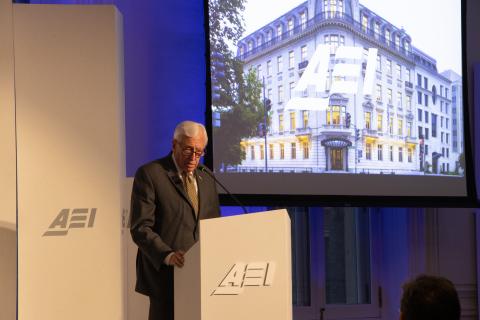
"I'm so pleased to be here with all of you. When I leave the Congress at some point in time, I will look back on two major pieces of legislation and others, but two major pieces, and I want to talk about both of them. One is the Americans with Disabilities Act, and one is the Help America Vote Act. And the reason I talk about both of them in terms of what I did in Congress during my years, was because I think both of them had a very significant effect, the ADA obviously a greater one in one sense, but, both of them will, I think, continue to have effects. The ADA has been carried out more perfectly, perhaps, than the HAVA has, in some senses, but both have had significant effect. John, thank you very much for your introduction. Is Don here? I’m looking at him. Don and Tom Hicks, my friend Tom Hicks at the EAC, and the rest of you have such an effect. Unfortunately, the person who wrote HAVA had to leave. You know, I take credit for being a sponsor and initiator, and I’m going to talk about Bob Ney. Obviously. But Keith was the one who really did a lot of the grunt work as those of you who worked closely with us know, as well as Paul and others on Bob Ney’s staff. Doug Lewis was a great help [and] worked hard on it. Thank you for being here, Doug, Leslie Reynolds and so many others who made a difference on this. So, I thank you for inviting me to talk a little bit about this bill.
"You know, they say the longest night of the year, normally occurs on the winter solstice coming up on December 21st. Well, the longest night of 2000 occurred on November 7th; it lasted 35 days. You all know the story, you’ve been hearing about the story, and talking about the story of an election in which 105.6 million Americans voted, came down to 537 votes. Americans' confidence in their democracy seemed to erode with each passing day, and each mention of arcane terms like ‘butterfly ballots’ and ‘hanging chads’ and they said, ‘What the hell is going on?’ Ultimately, the outcome was determined not simply by a margin of 271 to 266. I say often that Al Gore lost the election 5 to 4. That's not the way elections are supposed to be decided. They're supposed to be decided by the voters. That was not to be. And whether you agree with that decision or not, ultimately it was 5 saying that the election was over and 4 saying, ‘No, it's not.’ The majority ruled that Florida's recount violated the Equal Protection Clause, and there was no time to rectify the issues before the safe harbor deadline.
"Graciously, painfully, and patriotically, Al Gore conceded. In his speech, he said this: ‘The strength of American democracy is shown most clearly through the difficulties it can overcome.’ Again, I say that was an extraordinarily gracious, courageous, and patriotic stand for Al Gore to take. None of us on our side of the aisle thought that we lost that election. One of the proudest moments I've had over the last 44 plus years – 45 this May – was the inauguration of 2001 when Bill Clinton, Al Gore, George Bush sat within feet of one another, and the greatest power on earth was transferred peacefully without a shot from Bill Clinton to George Bush. That was democracy at its finest, even though so many of us believe that that was not the outcome, the strength of our [democracy] was shown that we accepted the 5-4 victory. Why? Because that's the law. That's what the Constitution says we should do. That was the goal of the Help America Vote Act, not simply to secure our elections, but to restore the strength of our democracy in the eyes of the American people. That task was bigger than any one person in any one party. From the start, I knew that HAVA would have to be a bipartisan piece of legislation. First of all, the Republicans were in charge. They were chairs of committee, so it was a practical matter that had to happen. But more importantly, it had to have a consensus that this was the right thing to do and we created that, it took some time. I learned that lesson, as I said, serving as the principal House sponsor of the Americans with Disabilities Act, a bipartisan bill passed in the Democratic Congress and signed into law by George H.W. Bush on July 26th, 1990.
"HAVA’s success relied on partnership across party lines, across chambers, across levels of government. Fortunately for the American people and for me, I found a receptive and positive partner in Representative Bob Ney. Bob Ney was as responsible for passing HAVA as any Member of Congress, including myself. Had he been a person who was going to oppose because it was a partisan issue, it would not have passed. But he was bigger than that, and more responsible than that, and a good friend. I made the case that an overwhelming bipartisan election reform bill was key to restoring American trust in its elections, so critical for any successful democracy. For over two centuries, the federal government had not devoted any of its resources – not a single dime – to the electoral process that determined who would serve in federal office. So, every president, every senator, and every Member of the House had been elected through a state-funded process, and that had to change. Bob Ney agreed. And as a result, we worked very closely, very positively, and very effectively together and he was under a great deal of pressure, Paul as you well know, from a lot of his Republican colleagues. He could have seized on that opportunity to push for partisan advantage as some in his party wanted him to do. Instead, we shared a focus on reaching a real solution, and we weren’t the only ones. Former Presidents Gerald Ford and Jimmy Carter led a commission on election reform. I had the pleasure, and Bob had the pleasure of testifying before the commission in Ann Arbor in 2001, and we incorporated many of their suggestions in the bill. I also worked very closely with the Secretaries of State. Thank you very much to those of you who represent the Secretaries of State.
"I remember, particularly, a Los Angeles County Registrar Conny McCormack, I don't know whether that name has been mentioned before but Conny was an essential part of working with Secretaries of State. She was not a Secretary of State, she was the local Los Angeles County [Registrar] and had one of the most diverse electorates, perhaps in the world and certainly in America. She was very, very helpful to us, as were so many Secretaries of State, Democratic and Republican. And again, Bob facilitated that bipartisan cooperation. Central to HAVA was the establishment of the Election Assistance Commission. We have two representatives of that commission here. It is not as strong as I would have liked it, but as strong as I would have liked it, it would not have passed, and Bob and I both realized that. That's why there were equal numbers, and, in fact, you have to have at least three quarters agreeing. And that gave confidence to both Republicans and Democrats that they could vote for this, and [it] would not be turned into a partisan confrontation. It can develop standards, share best practices, and issue grants to help states make their elections more accurate, more accessible, and more secure. I appreciate the presence of Mr. Palmer and Mr. Hicks, who have worked so long and so well together to effect - successful implementation of that which we were able to do in this legislation.
"The frustration that Americans felt, and that I had felt, was one of the key things that I inserted — and Bob agreed — to put in HAVA; and that was the provisional ballot process, which was already effected in some states, but not all. And there's nothing more frustrating for a voter to come to a precinct and be told, ‘Well, this is not in your precinct’ or ‘You did not — we didn't get this information from the county board or the municipal board or the state board of the city that you were a voter.’ And in the heat of the 12 hours, or 13 hours that that poll may be open, very hard to check on that. So, we now have provisional ballots implemented by the states, but nevertheless, every state is required to have the availability of provisional ballots so that every person who is eligible to vote can vote, even if that has to be checked over the next 24, 48, 96 hours, or even longer.
"I also incorporated the College Poll Worker Program. That's what these remarks say, but what it was a program I believe that was necessary. Why? Because as a practitioner of politics, for some period of time, about sixty years, I found that poll workers were doing something that I’m doing: getting older every day. (laughter) And as elections became more technology-driven – a controversy in and of itself, as we know – the older poll workers were not as facile with that technology as younger people and I thought to myself, how do we solve that? And the way I suggest that we solve it is [involving] young college students, essentially, and have a program at every college that would, in effect, contribute personnel to working on Election Day in a non-partisan way. That hasn't been nearly as successful as I would have hoped. There are programs that are being followed for that, but I'm still trying to make that work better. But the reason I bring it up, interesting enough, that part of the bill I was going to call the Help America Vote Act, telling every college student and high school student [to] help America vote, help them do it right, help them to have confidence in what they're doing. Now ultimately, the voting act that we were working on, there were literally scores of suggestions of the name of this bill. Mostly it could be the ‘John Lewis’ bill or the this bill or the that bill, and Bob felt it ought to have a generic name. And Bob said to me, ‘I know you have this ‘Help America Vote’ section regarding college [students], but can we use that for the whole bill?’ And of course, I said yes, and that's how it became named the Help America Vote Act.
"What we kept out of HAVA, however, was just as important to its passage is what we put in. Bob, and with me helping him, successfully diffused partisan push to include an onerous voter I.D. requirement, something we knew would sink the bill. It's still a relevant issue, it's still talked about a lot, but it would not have been a bipartisan bill nor would it have passed as overwhelmingly had we included such a provision. That is still a very controversial issue, as all of you know. We also proactively involved leaders on other committees with jurisdiction over the same areas of HAVA addressed to ensure we presented a united front. That experience that I had in 1990, or 1988, ‘89 and ‘90 working on the Americans with Disabilities Act, where we had at least seven committees had very great part of the jurisdiction of issues we were dealing with in the in ADA was applicable in HAVA, because there were a number of — the Science committee was one of them, machines and – but there were – the Judiciary clearly was one of those, but a number of committees. Paul, I'm sure you get a lot of heat from some of the committee chairmen. ‘Why are you doing this? Why are you doing that?’ And I want to thank Paul personally for the role he played, the positive role he played in getting this bill done.
"We also proactively involved leaders of other committees, as I just said. HAVA ultimately passed through the House with a full vote of 357 to 48, as I've said. When the Senate was slow to consider HAVA, Bob and I worked with Kit Bond, Chris Dodd, and Mitch McConnell. Mitch McConnell was very helpful in getting this bill done, and I don't want that to be forgotten. And of course, Kit Bond and Chris Dodd were very active in the Rules Committee, I guess they were not the House Administration or the Senate Administration – it was called the Rules [Committee]. The Senate finally passed in a vote of 94 to 2. Now, let me tell you about that vote, 94 to 2. That was, it was more controversial than that vote would reflect, and it was interesting. There were two people who were very concerned about its passage, but 94 to 2, which of course means the were only four senators who didn't vote on this bill. And George W. Bush signed it into law in October 2002, and like the ADA, without the Bush families, father and son, neither one of these pieces of legislation would be law today. So, I owe a great debt of gratitude to both of them.
"The only reason we were able to make it to that historic day was that we embraced the – what I called as Whip, I called as Majority Leader, what I call the ‘psychology of consensus.’ We need to have, in America, the psychology of consensus. We need to get up in the morning and say, ‘I want to be able to agree with my fellow citizens so that we can move America forward in a positive way.’ Unfortunately, too many of us get up with the psychology of confrontation. ‘Psychology of the other guy is wrong.’ The other person, the other gal is wrong. We didn't look for excuses to say, ‘No.’ We look for reasons to say, ‘Yes.’ We sought to do what was right rather than what was politically expedient. David Broder of The Washington Post called HAVA, and I quote, ‘The most significant piece of federal election law since the Voting Rights Act,’ which as all of you know was passed in 1965. The 2000 presidential election was a perfect case study on how democracy should not function, and the passage of HAVA was a shining example of how democracy should happen.
"Frankly, I doubt HAVA would be possible today, but the story of HAVA still has lessons today at a time when it often feels as though another long night has descended on our democracy. Some people thought we would never restore Americans' faith in their government after 2000. We proved them wrong then, and I am hopeful we will find a way to do the same today. Doing so now will require partnership, just as it did back then, just as it does always. I want to thank all of you for the roles you have played. So many of you played a significant and critical role in the – not only in the adoption of HAVA, but the implementation of HAVA. HAVA was a limited in scope vis-à-vis the authority of the EAC. The EAC is very much an advisory committee, and not a directory committee. Nevertheless, its’ advice and counsel, I think, have helped elections boards and officials all over this country and we need to keep doing that. Sadly, however, we have substantially reduced our financial contribution to the administration of elections and sadly, a little bit like this audience we have, the size, elections are not very interesting until they happen, and then they become very interesting, then they become very critical. But in the interim, whether it's a two-year cycle, a four-year cycle, a six-year cycle, in the interim, they do not draw the attention and the support that they need. This meeting, and your discussion here, will hopefully remind Americans that elections are critically important and their support of them is absolutely essential. Thank you very much."