Hoyer Delivers Keynote Address at St. Mary's College of Maryland Inauguration of President Rhonda Phillips
WASHINGTON, DC - Congressman Steny H. Hoyer (MD-05) delivered the keynote address at the inauguration of St. Mary's College of Maryland President Rhonda Phillips on April 17, 2026. Below are a video and a transcription of his remarks:
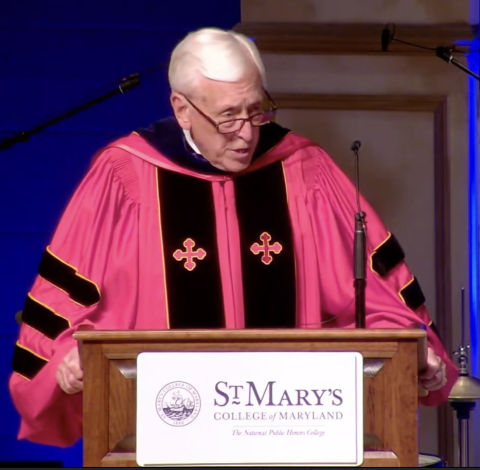
Click here to watch a video of his address.
“Thank you very much, John. It was in 1882 (laughter), or thereabouts, that I was appointed to the Board. And I keep trying to get off, and the governors won't let me. And I'm honored to be a member of the Board of Trustees, and I'm honored to be with all of you. President Phillips, President Jordan, Former Board Chair are here, and John Bell, who is our current Chair and does such an outstanding job. Reverend Humm, thank you for blessing this gathering. Stephen Croce had [been] such a critical component of the St. Mary's and Southern Maryland community, and President Lee, who has joined us from [the] Pittsburgh theological ceremony in which he's President – seminary, not ceremony. I want to thank our Chairman, John Bell, our fellow trustees here today, as well as the many faculty, staff, alumni, and, of course, students.
Each one of those components thinks they are the most important component. (laughter)
“Is Nancy Dodge here? Nancy, please stand. (applause) I am privileged to be the neighbor of Nancy Dodge and the former neighbor of Norton Dodge, her husband who passed away. Nancy, it is through your generosity and the generosity of your husband that this extraordinary facility is available to us. Thank you very, very much. (applause) President Jordan. Thank you. Thank you for taking us thus far on the way. (applause) You brought this community through the trials of pandemic, helped us confront Southern Maryland's history of slavery and segregation, and led a building effort on campus that will yield benefits for years and years to come.
“St. Mary's is not your average college. It's a place, in many ways, like no other. A liberal arts college for individuals who cherish education both for its ends as well as its means. A public institution whose impact is felt powerfully across Maryland, nationally and, yes, globally, and a source of immense pride for all of us here who believe in its mission and are working to grow its reach. I've had the honor of serving on the board for more than 30 years. In that time, the college has had four presidents, and now Dr. Rhonda Phillips is our fifth in my tenure. In their ten years, I have observed different approaches to meeting the challenges of presiding over a community of scholars. I told the Provost that from time to time, people have approached me, and I said, ‘No, I couldn't stand the politics of the college.’ (laughter) All of those who preceded have shared in the common same love for the purpose of public honors liberal arts college and an understanding of how critical this kind of institution is for all it serves. That purpose is twofold; clearly, to prepare students for success and to have a positive impact on the immediate community and the more global community.
“On the first, it's clear that St. Mary's is succeeding. Dr. Phillips very wisely began her tenure with a listening tour. I am sure that all your constituents were very pleased that you listened first, you took information in, you heard the concerns and the aspirations of all your constituents. And the report she released after her first 100 days, a series of figures tells the story of a college's success: ranked number five in the United States of America for best public liberal arts college. That's an applause line. (applause) 69 academic programs, 23 Division Three athletic teams, more than 350 alumni mentors enlisted to help students. One of the lowest faculty to student ratios in the country among institutions of its kind, and perhaps most important, 90% of graduates are either employed, in school, volunteering full time, or enlisted in the military six months after completing their degrees, that is a measure of success. (applause) On the second part, Princeton Review ranked St. Mary's College as number two in the United States of America in the country for making an impact. That is a measure of success. (applause) Globally, our graduates are leading in the expansion of science, medicine, and our understanding of the universe. Among the college's alumni are groundbreaking medical researchers, artists, builders, thinkers whose impact is felt across every part of our globe. St. Mary's graduates have also contributed to America's success through entrepreneurship, volunteerism and service to the nation. Here in Maryland, the college's impact has come from alumni who have gone on to serve as legislators and mayors.
“It is also felt every day in the archeological discoveries made right here in this historic place. St. Mary's City. Our deepening knowledge of how the first Marylanders lived and interacted with native peoples is present here, is discovered here. We see this local impact, too, in the ongoing efforts to preserve and sustain the St. Mary's River. Henry Mancini was sitting on the banks of the St. Mary's River, and the moon was ascending, and he wrote a beautiful song. (laughter) And he was proud of how the trio presented it today. Now, Nancy and I have a river as well. It's called the Patuxent River. And we love -Nancy [and I] – that moon coming up from the east over us on the western shore. Perhaps most important, though, is the college's impact on those who come here to learn and grow as individuals. A liberal arts education is one of the surest ways to transform someone into a wiser, more thoughtful, more tolerant, and more discerning citizen of his or her community, state, nation and planet. It teaches less how to answer questions and more about how to think analytically to get those answers.
“I came on the Board of Trustees when there was a gentleman named Stephen Mueller. Dr. Mueller had been the President of Johns Hopkins University, one of the great universities in the world. In the words of Stephen Mueller, the former President of Johns Hopkins who chaired the St. Mary's College Board of Trustees for some years, he said this: ‘A liberal arts education provides individuals with a framework of values.’ Not a fact of this, that, or others, but a framework of values. And ladies and gentlemen, the world is crying out for world citizens and U.S. citizens who have a framework of values. Mueller warned of universities producing what he called ‘highly skilled barbarians’ by focusing too much on knowledge and not enough on wisdom. That warning resonates as strongly today as when Dr. Mueller issued it in 1980. Six years later, he posed a critical question: ‘What is the role of the modern university or college President?’ Particularly, he noted this question matters when many of these institutions have grown into such administrative behemoths, that the President has become, and I quote Dr. Mueller, ‘An office rather than a person, a symbol more than a reality.’ Thankfully, even as St. Mary's has grown in impact, it remains of of size where its President is no mere symbol, but someone accessible to all. Otherwise known as ‘The Listening Tour: Accessible to All.’ Accessible to all who can foster meaningful relationships with faculty, students, and alumni. That synergy is critically important to further success. Instead, you have a chance to harness it, to shape it, to elevate it, much as your seven predecessors had to use that office. To bring together all who cherish this institution and channel our common efforts towards meeting the challenges that lie ahead. And those challenges, as all of us know, are daunting.
“We are experiencing a profound shift in technology and values that affect not only how we all live and work, but how students learn. Institutions of higher education are on the front lines of this transformative transformation. Those who lead these institutions will have to stay ahead of it by asking new questions. How can we train young people to think for themselves when A.I. promise to do the thinking for us? How can we teach students to lead with empathy and tolerance amid a global epidemic of negativity, division, and mistrust? How can we foster citizenship and community engagement without allowing timeless institutions of higher learning from being distracted by the contentious politics of the moment? In seeking a framework through which to approach these questions, I will turn once more to Dr. Mueller, who loved St. Mary's College and saw in its purpose so much promise. As President of Hopkins in the ‘80s, he wrote of his fellow college and university presidents, ‘We are presiding–’ and I quote ‘ – over the transition of our institutions into an era of communication –’ this was 1980
‘– of knowledge stored, recalled, displayed, and manipulated in staggering quantity and with dazzling speed.’ How prescient that was. He went on to say, ‘We are each of us builders. Our task is to help to remodel our institutions for tomorrow. for the students who come anew each year, for scholars who will acquire knowledge that yellow eludes us from discoveries and techniques that will enhance the human condition anew.’
“Dr. Phillips, now we look to you to be a builder. The board made its selection because we see in you the experience, the skills and personal qualities required to remodel St. Mary's College for an uncertain tomorrow. Those who have worked as your predecessors have done extraordinary jobs. At Chatham, you led efforts to make the university more financially sustainable, to engage alumni to expand athletics, and to build partnerships with the surrounding community. That's why Steve is here. The most significant economic presence, not only in Southern Maryland, but in Maryland, and one of the most significant in our state. As a scholar of city and regional planning, you've written and taught about how to build stronger and more sustainable communities physically and psychologically. You have been a trailblazer and a leader. All of this and St. Mary's experience will serve you well as you pursue your presidency, for your ability to connect, process with purpose, for your recognition of the role a liberal arts college has in making an impact globally, nationally, and locally for the individuals and for those whom they interface with.
“You understand, Madam President, you understand as we do, that the liberal arts college remains a bulwark against illiberalism, inequality, and injustice. That, faculty, is an extraordinary personal responsibility that each of you have and that each of us shares. When others question the value of a liberal arts education, you will now carry the banner of St. Mary's College and hold it up as an exemplar. As you've already started doing in your first 100 days and beyond, ask the tough questions and challenge us. Challenge the students, challenge the faculty, challenge the community to be engaged and always ensure that this college's purpose begins and ends with its students, who must always find here a framework of values to guide them as they become instruments of impact wherever life leaves, that they should always cherish learning for learning's sake. Dr. Phillips, as you embark officially on your tenure as the eighth president of St. Mary's College, I hope you will do so, and I know you will do so with the comfort and reassurance that you have our blessings and our support behind you now, our campus and a community ready to build with you. The components of this campus, articulated through four individuals, pledged that support. Go forth, Madam President, lead, inspire, build and realize excellence. Godspeed.”